
Harold's Resourcefulness
Harold and the Purple CrayonHarold repeatedly responds to an obstacle by drawing a solution, but the Dragon episode reveals the limits of control and the importance of recovering composure.
increasing Bearing strength in each event
 decreasing
Bearing strength in each eventdecreasingSolving the First Problem

A Practical Imagination
Needs become designs
Harold recognizes that his moonlight walk has no Moon and no surface on which to walk. He does not wait for circumstances to change; he creates the elements needed to begin.
Confidence in action
A long straight path is meant to keep him from getting lost. His early ingenuity expresses confidence that a problem can be met directly with the crayon.
Fear and Disorientation

Resourcefulness Under Strain
A design exceeds its purpose
Harold makes the Dragon to protect the apples, but the guardian frightens him as well. The creature is a solution that introduces a new problem, showing that creation can have consequences he did not intend.
Composure falters
Harold backs away, and his hand shakes around the crayon. His resourcefulness is momentarily compromised, and the resulting transition into the ocean makes the danger of panic tangible.
Wits Retained
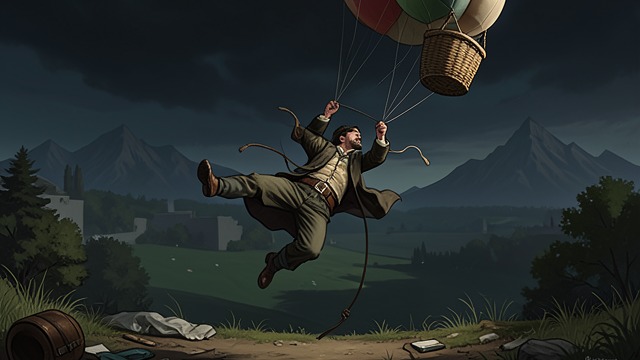
Recovering Control
A crisis without a path
Harold falls in thin air after the mountain's other side proves absent. The carefully imagined route has become a situation that demands immediate improvisation.
Invention as rescue
He keeps his wits and crayon, draws a balloon, and adds a basket. This response does not instantly bring him home, but it turns an uncontrolled fall into a survivable search.
At the beginning, when the walk lacks a Moon and path
In the forest episode, when the Dragon frightens him
During the mountain fall, after Harold slips
